
How the Described Benefits of Unified Democracy Are Proposed Achieved in a UK Deployment
This page expands on the Generic Description of Unified Democracy by providing further detail proposed for its specific Westminster-based UK Deployment. It therefore pre-requires a an understanding of the preceding pages of this website.
The Executive
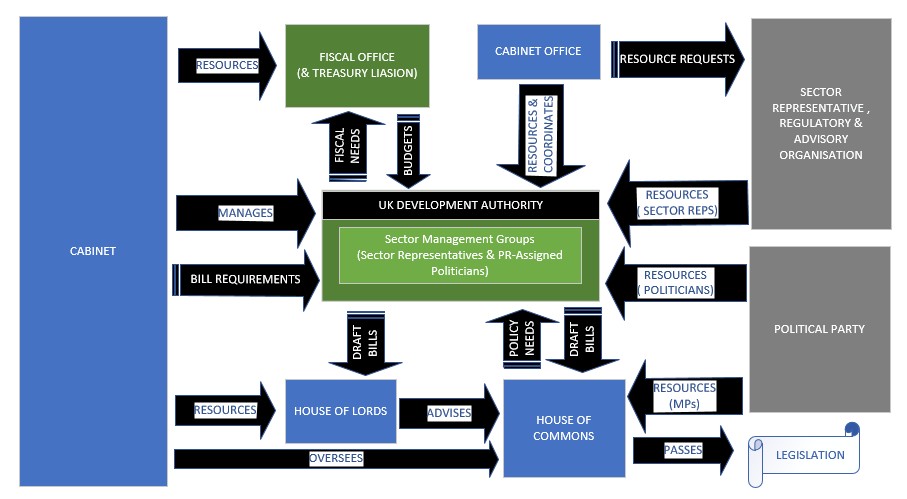
To enable the significant shift in Government capability that Unified Democracy requires, it is proposed that the role of the Cabinet Office would be extended and a new branch of The Executive be introduced (shown in Green):
– The Cabinet Office. Its current role would be extended – mainly to Service the new Development Authority. In particular, in the supply and coordination of Sector Representatives (though liaison with Representative, Regulatory & Advisory Bodies), and in ensuring optimum democratic formation of Sector Management Groups. Further, in managing their cross-sector coordination (intended to be supported By AI as available).
– The UK Fiscal Office – led by The Chancellor. This would be a slimline office resourced professionally (including the OBR), to provide a much higher level of expertise in Fiscal Policy (essentially Budgetary Control, Taxation & National Debt Management).
Development Authority – Sector Mamagrment Groups
The Development Authority is proposed to consist of an aligned autonomous structure of 13 SMGs – under the overall direction and management of the Prime Minister, each managed by his/her appointed Minister. The overall structure is proposed as follows:
(1) Citizenship & Immigration (2) Foreign & EU Affairs (3) Police, Justice & Prisons (4) Business, Hospitality & Tourism (5) Jobs, Pensions, Social Security (6) Housing, Building & Local Government Coordination (7) Ecology, Food, Water, Rivers, Coasts (8) Health & Social Care (9) Education (10) Energy Infrastructure (11) Transport (12) Technology, Communications, Media, Culture & Sport (13) Defence (under special security).
These SMGs would be coordinated by the Cabinet Office and each come under the budgetary control of the Fiscal Office (both of these functions supported by AI when available). It is proposed that each SMGs 1 and 2 Consist of Politicians only, the others an equal number of Politicians and Sector Representatives. The resourcing of the SMGs would obviously be flexed in accordance with each Parliamentary Agenda.
Politicians
A Total of 260 Politicians are initially proposed for the UK (an average of 20 per sector). Politicians are always appointed directly proportionate to their Party’s Popular Vote – as previously described (the vast majority also being MPs that would attend both the Development Authority and House of Commons).
The assignment of politicians to particular SMGs would depend on the current Parliamentary Agenda in relation to their Party’s ethos and its number of Politicians. This would be arranged in liaison between the Party Leader and the Cabinet office.
However, general guidance would be to manage the assignment starting with the Party(s) with the least number of politicians, ending with the Governing Party, (with the most). Also ensuring that Parties spread their Politicians across Sectors as evenly as possible, so as not to undemocratically influence policy in particular sectors
Sectors Representatives
These individuals would be policy specialists seconded to the UK-DA by the UK’s various representative, advisory and regulatory bodies. There are proposed to be 220 (an average of 20 for each of 13 Sectors, but excluding Sectors 1 and 2 (related to the Home Office & Foreign Office), proposed as being purely political.
It is proposed that Sector Representatives not be paid by the taxpayer – but paid by their employers to drive-up the knowledge and know-how of Government in their particular sector, so as to maximise its performance and of its individual enterprises.
It is propesed that, to ensure strategic continuity of policy, Sector Representatives would be deployed every 30 months, but offset 30 months from Politicians. Enabling each Administration to carry-forward Government know-how to the next.
House of Commons
It is proposed that this be changed from its current adversarial format to a flat debating chamber as previously described. The number of MPs and constituencies unchanged, Party Whips being abolished. Other procedural changes as previously described.
House Of Lords
It is proposed that this chamber temporarily continue in its current role as an advisory body – to both the Executive and House of Commons. However, this chamber is not a requirement within the Unified Democracy system and is out of kilter with its ethos.
Post-deployment, no new Lords would therefore be appointed, and the size of this house would therefore gradually diminish under natural redundancy -wound-up as and when appropriate. The use of its premises would then be evaluated for its ongoing use – perhaps as a UK-wide democratic forum on inter-country issues of common concern – enforcing UK cohesion.
The Three Devolved Governments
It is proposed that Unified Democracy initially be implemented for the UK as a whole, forming an upgrade of the current Westminster-based system. The three Devolved Governments, as now, would elect MPs to the House of Commons, with Westminster Politicians elected and assigned proportionately at the overall-UK level.
When the upgraded system is bedded-in, it would be the choice of their People whether or not they would wish to transition to a similar model (perhaps via a referendum).
 Unified Democracy Party (UK)